How a vacuum dryer works
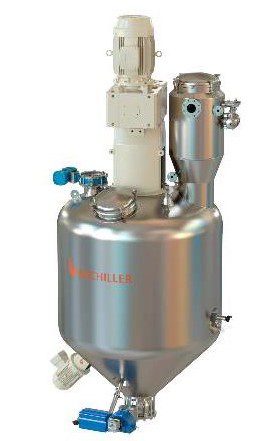
How a vacuum dryer works — definition: A vacuum dryer removes moisture by reducing the pressure in the drying chamber to 1–50 mbar, which lowers the boiling point of water to 7–33°C. Heat is supplied to the product indirectly via heated walls or a steam jacket; the evaporating moisture is captured by a condenser. Compliant with PED 2014/68/EU, GMP Annex 1 and ATEX 2014/34/EU.
The operating principle of the vacuum dryer is based on the thermodynamic relationship between pressure and boiling point: the lower the pressure, the lower the temperature at which water boils. At 10 mbar absolute pressure, water already boils at 7°C — this makes it possible to dry thermally sensitive materials at temperatures that are safe even for the most delicate biological and pharmaceutical products.
Hecht Technology supplies vacuum dryers where the complete thermodynamic design is optimised for your material: heating system, vacuum pump selection, condenser capacity and agitator geometry together determine drying speed, uniformity and product quality. Our systems are certified for GMP, ATEX and EHEDG applications.
Frequently asked questions about how vacuum dryers work
How is heat transferred in a vacuum dryer?
In a vacuum dryer, heat transfer takes place exclusively via indirect means (convection is minimal at low pressure): (1) contact heat transfer via heated walls, discs or paddles — the most common principle in disc and paddle vacuum dryers; (2) steam-jacket heating (most common: steam plates on the wall and agitator, temperature 80–150°C depending on steam pressure); (3) hot-water jacket at lower temperatures (40–80°C) for thermally sensitive materials. Agitation increases heat transfer by continuously bringing fresh material into contact with the heated surfaces (NTU model per VDI Wärmeatlas).
How do the vacuum pump and condenser work together in a vacuum dryer?
The condenser sits between the drying chamber and the vacuum pump. Vapour released from the product is first condensed in the condenser at -10 to +10°C (coolant) — this removes 90–99% of the vapour volume. Only non-condensable gases (air, N2) reach the vacuum pump. This protects the vacuum pump from solvent vapours, significantly reduces the required pump capacity and enables solvent recovery. For organic solvents, the condenser is also the primary ATEX safety measure (concentration kept below the LEL per 2014/34/EU).
Which factors determine drying speed in a vacuum dryer?
Drying speed is determined by: (1) temperature difference between the heating medium and the product (the driving force for heat transfer — a higher ΔT gives faster drying but a higher risk of degradation); (2) contact area between the product and heated walls (depending on fill level 40–70% and agitator geometry); (3) vacuum pressure (lower pressure = higher vapour-pressure driving force, but also a lower maximum product temperature); (4) material properties (bulk density, thermal conductivity, moisture-binding energy); (5) agitation speed (higher agitation speed improves heat transfer but increases the risk of particle breakage for fragile crystals).
Read also
- Spray dryers for herbs and spices: the guide
- Vacuum drying: technology choice for pharma and chemicals
- Powder transport in closed systems: 7-step guide