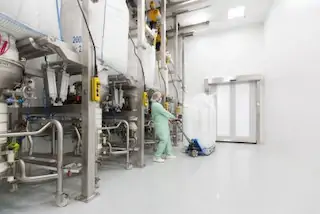
When filling dry foods, hygiene is an essential part of the production process. Powder filling machines are used for drink mixes, herbs, spices, food supplements and other dry ingredients.
During production, product residues can build up in augers, hoppers, dosing units and hard-to-reach machine parts. Regular cleaning is necessary to prevent cross-contamination and allergen carry-over.
Yet wet cleaning is not always the best solution. With dry foods, adding moisture can actually introduce new microbiological risks.
Why wet cleaning of dry products needs attention
Dry foods usually have a low water activity, which prevents many micro-organisms from multiplying easily. That does not mean dry products are automatically microbiologically safe. Certain pathogens, including Salmonella, can survive for long periods in dry foods.
When a dry production environment is made wet in an uncontrolled way, damp spots form in which micro-organisms can develop under suitable conditions. For many dry foods, a controlled dry cleaning process is therefore preferred, unless the specific installation and hygiene procedure require wet cleaning.
The right method depends on the product, the microbiological risk assessment and the cleanability of the equipment.
Which parts deserve extra attention?
In powder filling machines there are several locations where product residues can build up. Pay particular attention to parts with limited accessibility:
- Dosing augers and auger tubes.
- Product hoppers.
- Agitators.
- Outlets and filling spouts.
- Seals and connections.
- Horizontal machine surfaces.
- Areas around the packaging and sealing unit.
If these parts are not easily accessible, product residues can remain and come back into contact with the product in the next production run. Cleanability must therefore be considered during the selection and design of the installation.
Dry cleaning: controlled and reproducible
In dry powder processes, dry cleaning can be an effective method. Product residues are removed without adding unnecessary moisture to the production environment. Possible techniques include:
- HEPA-filtered industrial vacuum cleaners: the filter configuration and suitability must match the dust properties and hygiene requirements.
- Dedicated cleaning tools: use suitable brushes and other tools per product group or production zone to limit cross-contamination.
- Removable product contact parts: parts that can be removed without tools make inspection and cleaning considerably easier.
- Controlled cleaning procedures: record which parts are removed, how they are cleaned and how it is verified that the installation is fit for production again.
Using compressed air to blow away powder residues is generally undesirable. Dust and possible contaminants then spread further through the environment.
When is wet cleaning necessary?
Dry cleaning is not sufficient for every application. For certain product changeovers, microbiological risks or specific allergens, wet cleaning may be necessary. In that case it is important to clean the removable parts in a controlled way in a suitable wash room.
After cleaning, these parts must be dried completely before they are returned to the production environment. Also prevent moisture remaining in cavities, seals and hard-to-reach connections. A good cleaning protocol therefore describes not only how the machine is cleaned, but also how it is verified that it is dry and ready for production again.
Allergen control: ATP alone is not enough
For product changeovers, it is important to distinguish between general cleanliness and the actual removal of allergens. ATP measurements can help assess general cleaning results, but they are not specific enough to demonstrate the absence of a particular allergen. Additional checks are needed for that.
Consider:
- Visual inspection of product contact parts.
- Inspection of augers and dosing units.
- Allergen-specific swab tests.
- Documented acceptance criteria.
- Validation of the cleaning procedure.
This makes it easier to demonstrate that the installation is suitable for the next production batch.
Less dust during production means easier cleaning
The amount of dust released during production directly determines the cleaning effort. When powder ends up outside the hopper during filling, it spreads over machine frames, seals and surrounding surfaces. That increases not only the cleaning work, but also the risk of cross-contamination.
A closed product feed can limit this problem at the source. Consider:
- Vacuum conveying from a raw material container.
- Closed docking of bags or containers.
- Controlled feeding to the filling hopper.
- Local dust extraction at critical transfer points.
Reducing dust formation during production also makes cleaning the installation easier.
A cleanable installation starts with design
When selecting a powder filling machine, it is wise to look beyond capacity and dosing accuracy. Also ask these questions:
- Which parts come into direct contact with the product?
- Which parts can be dismantled without tools?
- Where can powder residues remain?
- Which cleaning method suits the product?
- How are allergens and microbiological risks controlled?
- How is dust prevented from spreading during production?
At Hecht Technology we look at powder handling and containment from the perspective of the complete process. A well-designed feed system not only limits dust formation, but also contributes to a more manageable cleaning strategy.
Conclusion
Cleaning powder filling machines requires an approach that suits the properties of dry foods. Dry cleaning is often a suitable method for removing product residues without introducing unnecessary moisture. Removable product contact parts, HEPA-filtered dust extraction and validated allergen checks support a reliable cleaning process.
TL;DR: Wet cleaning is not automatically the best choice for dry foods. Control dust formation, make product contact parts easily accessible and use a validated cleaning procedure. A closed feed to the filling machine can also reduce the cleaning effort.